What Is the Year 2038 Problem?
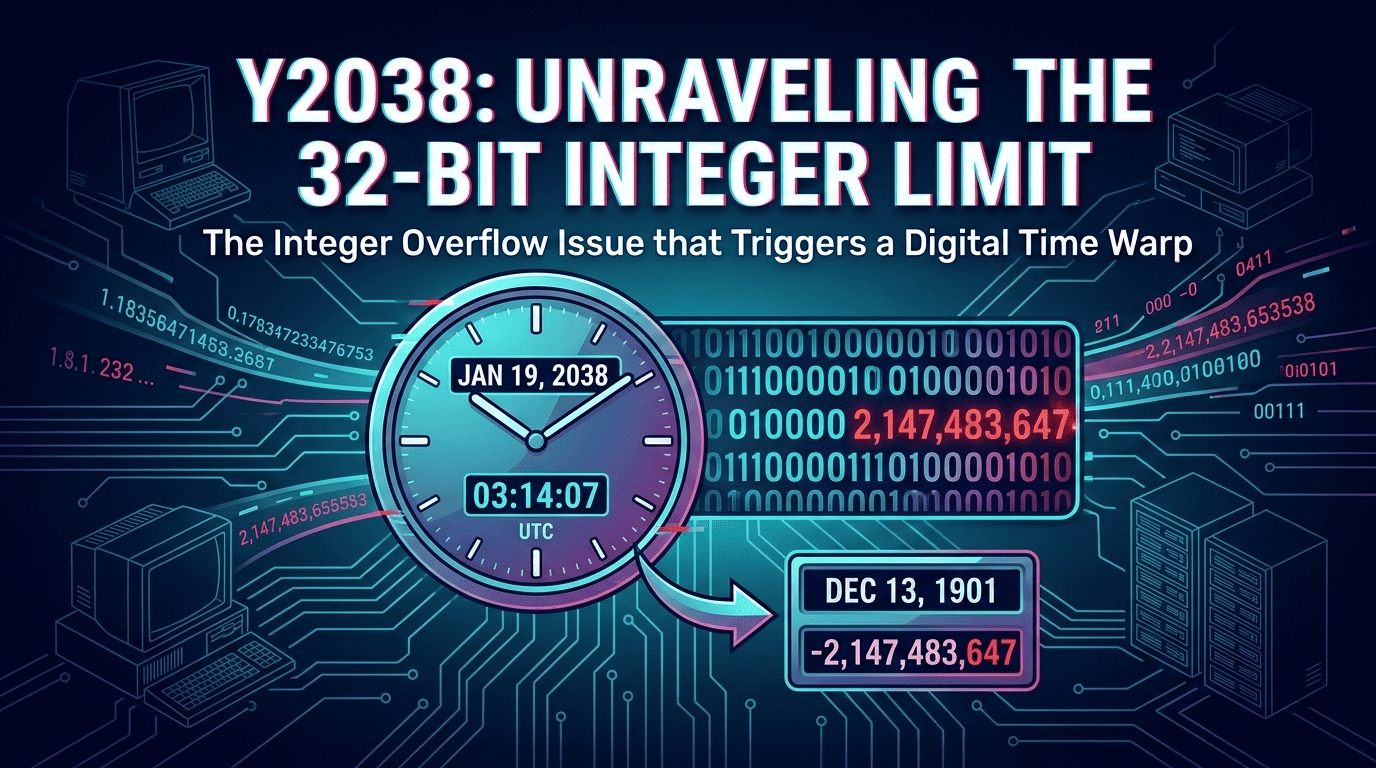
The Year 2038 problem sounds like something from an old textbook, but it is still a real concept in computing.
At its core, it is an integer overflow issue tied to how some systems store Unix time.
The short version
Some older systems store time as a signed 32-bit integer counting seconds since the Unix epoch (1970-01-01 00:00:00 UTC).
A signed 32-bit integer can only go up to:
2147483647
That value corresponds to:
January 19, 2038, 03:14:07 UTC
One second later, the value overflows.
In a typical two's-complement interpretation, it wraps to a negative number, which points to a date in December 1901.
So time appears to jump backward by more than a century.
Why this happens mathematically
A signed 32-bit integer uses one bit for sign and 31 bits for value range.
That gives:
- minimum:
-2147483648 - maximum:
2147483647
If your clock counter is stored in that type, it cannot represent values above the maximum. The next increment wraps around.
So this is not a timezone issue, not a calendar issue, and not a leap-year issue. It is a numeric range limit.
What can break when overflow happens
Any feature that relies on future timestamps can behave strangely if it receives wrapped values.
Possible effects include:
- incorrect ordering of events
- bad expiration checks
- invalid schedule calculations
- wrong log timelines
- weird date displays
In plain terms, systems may start treating valid future times as very old past times.
Which systems are most relevant to the topic
Modern 64-bit environments have reduced the risk a lot, but the topic still matters for understanding compatibility and legacy behavior.
The concept is most associated with:
- old 32-bit software stacks
- long-lived embedded systems
- legacy binaries or protocols built around 32-bit time fields
This is why Y2038 is still discussed. Not because all software is broken, but because some software ecosystems age slowly.
Is the problem already solved everywhere?
No, but a lot of progress has been made.
Many modern systems now use 64-bit time representations, which push the limit so far into the future that it is not a practical concern for current software lifetimes.
In other words, the industry did not ignore Y2038. It has been actively migrating away from the risky representation.